Pages

Thursday, December 18, 2025

Rabbi Eliezer Diamond Dies at 73

Beloved Teacher: With great sorrow, Abq Jew announces the passing - one week ago today - of one of his first Torah (in the general sense) and (more specifically) Talmud teachers, Rabbi Eliezer Diamond.

Rabbi Eliezer Diamond

The Jewish Telegraphic Agency (JTA) reports:

Rabbi Eliezer Diamond, beloved Jewish Theological Seminary professor and author, dies at 73

Over his illustrious career as a rabbinic scholar, Diamond mentored generations of rabbis.

Rabbi Eliezer Diamond, who taught at the Jewish Theological Seminary for over three decades and left an indelible mark on generations of rabbis and Jewish scholars, has died.

Diamond died Thursday at 73, following several years battling multiple forms of cancer.

Born in 1952, Diamond received his bachelor’s and master’s degrees and rabbinical ordination from the Rabbi Isaac Elchanan Theological Seminary of Yeshiva University from 1968 to 1977.

But it was at JTS, the Conservative flagship in New York City, where Diamond earned his doctorate in Talmud and was the Rabbi Judah Nadich Professor of Talmud and Rabbinics, that his talents for mentorship and teaching flourished.

Old Lincoln Square Synagogue

Yes, Abq Jew was also at JTS, the Conservative flagship in New York City. But Abq Jew never had the privilege of learning with Rabbi Diamond there.

But Abq Jew did have the privilege of learning with Eliezer Diamond at NYC's Orthodox flagship, the famed Lincoln Square Synagogue (the old building, as pictured) during the summer of 1974.

Here is how Lincoln Square Synagogue got started:

In 1964, in the living room of Emma and Danny Mars's apartment in Lincoln Towers, a part-time rabbi from Yeshiva University named Steven Riskin took the budding Lincoln Square Conservative Synagogue by storm. 

 His originality, charm and boundless energy captivated members and moved them to a more traditionally observant Judaism, in turn sparking a growing Jewish renaissance on Manhattan’s Upper West Side.

Before long, a new synagogue-in-the round made its debut at 200 Amsterdam Avenue, and the excitement at the renamed Lincoln Square Synagogue brought hundreds of young single professionals to the neighborhood, creating a vibrant scene for mixing and matching. 
 
Young families were also drawn to LSS, attracted by the dazzling teachings of Rabbi Riskin, assisted by Rabbi Herschel Cohen z”l and Rabbi Ephraim Buchwald, and the gorgeous melodies of Cantor Sherwood Goffin. 
 
“The New Orthodox” they called it on the cover of New York Magazine. Who knew? 
 
But as members struggled to navigate between the laws of Jewish tradition and the secular values of the surrounding society, Lincoln Square Synagogue began to see its destiny.

In the summer of 1974, Eliezer Diamond was "just" a YU rabbinical student; Abq Jew was newly arrived from California with little formal Jewish education; and Lincoln Square Synagogue was just getting started.

Just down the street from the temples of high culture at Lincoln Center, Lincoln Square Synagogue quickly established itself as a temple of an innovative kind, showcasing the classical and the contemporary, history and modernity. 
 
With joy and pride, the challenges of present-day living were brought into harmony with the ancient traditions passed down through the generations. 
 
The sacred liturgical texts of tefillah were infused with a new vitality as haunting, time-honored melodies shared the stage with the music of Shlomo Carlebach and The Rabbi’s Sons. 
 
The thirst for wisdom was quenched with the scholarship of Rashi and Rambam blended with the insights of 20th-century thinkers like Rabbi Abraham Isaac HaCohen Kook and Rabbi Joseph Dov HaLevi Soloveitchik. 
 
Everything old was new again.

Rabbi Shlomo Riskin

But Rabbi Steve Riskin was already Rabbi Steve Riskin - the NYC go-to guy if you were young, Jewish, and wanted to learn. Literally! When Abq Jew was searching, everyone told him: Go to Riskin! 

Here is what Wikipedia tells us:

Steven Riskin graduated valedictorian, summa cum laude, from Yeshiva University in 1960, where he received rabbinic ordination under the guidance of Rabbi Joseph Soloveitchik.

At the age of 23, Riskin became the founding rabbi of Lincoln Square Synagogue in New York City and served in that position until 1983. Rabbi Riskin transformed the Conservative minyan into one of New York's most innovative and dynamic Orthodox communities. 
 
The synagogue became particularly well known for its pioneering outreach programs which inspired many secular people to become religiously observant Orthodox Jews.

In 1983, Steve Riskin became Shlomo Riskin when he immigrated to the Israeli settlement of Efrat in Judea with his family. There he became the founding Chief Rabbi, a position he held until 2020.

These are days

Eliezer Diamond, of blessed memory, was one of a very small number of YU rabbinical students who Rabbi Steve Riskin brought to LSS in 1974 to instruct and guide and, perhaps, inspire us - an only slightly larger group of young, searching Jewish semi-professionals - in a summer of engagement and learning.

That is where Abq Jew first met Eliezer Diamond, and it is from those days that Abq Jew fondly remembers him. After all these years.

And from those who knew Rabbi Eliezer Diamond more closely, a note from JTS Chancellor Shuly Rubin Schwartz:

From JTS

Dear JTS Community,

The Jewish Theological Seminary joins colleagues, friends, family, and students in mourning the passing of Rabbi Eliezer Diamond z”l, the Rabbi Judah Nadich Professor of Talmud and Rabbinics, who died last evening at home.   

Rabbi Diamond was an honored scholar, trusted religious and spiritual leader, and transformational Talmudist. 

Rabbi Diamond taught courses in Talmud and Rabbinics at JTS for more than 35 years, retiring approximately one year ago. 

Generations of students were profoundly shaped by his inspiring teaching. His influential writings on prayer, asceticism, rabbinic narrative, and issues of environmental law and ethics have enriched the broader Jewish world. He is the author of Holy Men and Hunger Artists: Fasting and Asceticism in Rabbinic Culture and was at work editing a commentary on Yerushalmi Pesahim written by JTS Professor Louis Ginzberg (z”l). 

Rabbi Diamond was not only an intellectual powerhouse, but had a deeply spiritual core. The combination of his intellect and his sensitivity gave him a unique perspective on how to analyze texts, approach the liturgy, and live as an observant Jew.  As a dean, I saw at close range for decades how devoted he was to his teaching and to his students.  

Provost Jeff Kress shared that Rabbi Diamond’s passing is a profound loss to our community. He said, “The gift of Eliezer was not only in how much he knew, but in how generously he shared that knowledge with all those around him.” 

Rabbi Diamond received his BA, MS, and Rabbinic Ordination from Yeshiva University and earned his PhD in Talmud at JTS. 

We know that many outside the JTS community are grieving as well since Rabbi Diamond’s impact extended far beyond our campus. Students at Stern College, Hadar, Drisha Institute, the Reconstructionist Rabbinical College, the 92nd Street Y, and several Ramah camps were fortunate to learn from him throughout his long career. 

May Rabbi Diamond’s memory always serve as a blessing for all those whose lives he touched. 
 
Chancellor Shuly Rubin Schwartz


A blessing

Wednesday, November 5, 2025

Elected in New York City

What A Place To Be! So - as Abq Jew is sure you've heard - there were elections held throughout the United States yesterday. Important elections, whose results may determine the course of events far, far into our future.

Election 2025

Or then again, maybe not. 

Abq Jew certainly hopes that turns out to be true in New Jersey, his former home state, where Mikie Sherrill, who would have been his US Representative had he skipped over 15 wonderful years in Albuquerque and remained in Livingston, is now the Governor-elect!


Mikie Sherrill

And then there's New York City.

Abq Jew certainly hopes that turns out to be flagrantly untrue in New York City, his former home base, where Zohran Mamdani, born in 1991, thirteen (13) years after Mr & Mrs Abq Jew left The Big Apple, is now the Mayor-elect.

Zohran Mamdani is a Democratic Socialist. He is also, at best(?), an anti-Zionist, but, at worst, an antisemite (for those who insist upon a distinction, albeit one with no difference). Most Jews have long recognized this (although some, amazingly, have not), and await his time in office with trepidation. 

Rabbi Angela Buchdahl, of NYC's Central Synagogue, spoke out about this before the election.


In her sermon for Parshat Lech Lecha (Get Outta Here).

Do not despair!

Abq Jew firmly believes that it's not time to despair ... yet. And Dr Einat Wilf, in an X post, offers an important story ... and an intriguing question.

Lately I reflect often on the difference between historical and personal time. I imagine a Viennese Jew, let's say the year is 1902, he is 37. He is living in the best time in the best city for Jews, pretty much ever. His mayor is Karl Lueger and there is this ambient antisemitism, but life is really really good for the Jews in Vienna. In its cafes they are hatching ideas that will define humanity for the coming century. 

Now, there is this guy Herzl, who clearly, from the perspective of that Viennese Jew, who is similar in age to Herzl, went a bit nuts. Why else would a man who scaled the heights of Viennese society, was the respected editor of what would be today a combination of the opinion, arts, travel, and literary pages of the NYT, suddenly start writing about a Jewish state and even going mad organizing for it and building its institutions and lobbying world leaders for it?

Now, let's imagine this Viennese Jew dies in 1937, at the age of 72. He passed his life in the best city during the best times for Jews in that city. When he dies, he still thinks, despite the gathering storm next door, that Herzl was crazy.  

So, reflecting on the difference between historical and personal time, what do you think, would this Jew have been better off immigrating in the early 20th century to a malaria ridden tract of land in the Ottoman Empire or living in Vienna until his death?

Abq Jew must point out (he must! he must!) that, of all the many and varied Jewish organizations that have condemned Zohran Mamdani and his odious views - there is one prominent, well-known Jewish organization that has taken a somewhat different stance.

Zohran Mamdani

Abq Jew
 must also point out (he must! he must!) that he was initially convinced that it was noted (pardon, or not, the pun) long-time Jewish performer

Mama Doni
Mama Doni

aka Doni Zasloff, these days a significant part of Nefesh Mountain (see September 2021's Ready For the Times), a New York-based progressive bluegrass band, who had been elected New York City Mayor. 

Nefesh Mountain

That would have been charming! And entertaining!

Tuesday, September 16, 2025

Rosh Hashanah 5786

Dip Your Apple In The Honey: It's Rosh Hashanah! And, as we begin a New Jewish Year, please remember - as Rabbi Adam Rosenbaum of Denver, CO; of Livingston, NJ; and now, once again, of Charleston, SC has taught us -

There is hope for the world.
There is hope for your life.

The way it is now is not the way it must be. 


Abq Jew warmly invites you to check out
this now-classic Rosh Hashanah hit from 5772:
Dip Your Apple!


No apples, pomegranates, babies, or smartphones
were harmed in the filming of this video.
Please don't feed babies honey.

===============================

Rosh Hashanah and Yom Kippur, Abq Jew knows (and knows you know), are special times for our Jewish hearts, minds, and souls.

The Ein Prat Fountainheads have - as always! - touched our hearts. Now, here is something that will touch our minds and souls.

18Doors

From Rabbi Robyn Frisch, in 18 Doors:

6 Ways To Celebrate Rosh Hashanah 
Without Attending Synagogue
1. Have a Rosh Hashanah Seder

Many Sephardic and Mizrahi Jews have a seder on the first night of Rosh Hashanah. This seder, which has its origins in the Talmud, is called a Seder Yehi Ratzon (“seder of God’s will”).

2. Have a Special Meal

There are lots of foods traditionally associated with the holiday that you can include with your meal, such as apples dipped in honey (for a sweet new year); a round challah (which reminds us of the circle of life, as well as the cyclical nature of the passage of a year); and pomegranates (it’s been said that there are 613 seeds in a pomegranate, corresponding to the 613 commandments in the Torah).

3. Do Tashlich

On the first day of Rosh Hashanah to go to a running body of water (preferably one with fish) and symbolically cast away your sins.

4. Engage in Cheshbon HaNefesh (“Accounting of the Soul”)

Rosh Hashanah is a great time to take stock and to think about—and maybe discuss with others—aspects of yourself that you would like to improve upon in the year ahead, as well as those things you’re proud of from the past year.

5. Do Teshuvah (“Return,” “Repentance”)

On or before Rosh Hashanah, you can ask people for forgiveness for things you have done to hurt them in the past year, and you can resolve not to commit the same wrongdoings in the future.

6. Spend Time in Nature

Rosh Hashanah is, after all, the Birthday of the World, so why not spend part of the day enjoying the natural beauty of the world?

Hold tight

L'Shana Tova Tikatevu –
May you be inscribed for a good year!

Rosh Hashanah

3 Million Page Views

The first Abq Jew Blog post was published on September 19, 2010.
Ten years later - on October 10, 2020 - we hit 1 Million.
And now, after fifteen years - we're over 3 Million!

Tuesday, August 26, 2025

Fall 2025 @ OASIS Abq

 Great Courses of Jewish Interest

Star of David

Abq Jew is pleased to inform you that
OASIS Albuquerque has just announced
their Fall 2025 line-up of classes!
Registration opens on

Wednesday September 3
but you can Wish List your selections now.

OASIS Abq

OASIS Albuquerque Executive Director Scott Sharp and his staff continue to bring you new and interesting class offerings, and continue to make sure there are courses of Jewish interest.

Fall 2025 Oasis

This session's courses and instructors include,
but are by no means limited to:

Going to Baht

Going to Baht
for the Jewish Community in Bangkok
Wednesday September 17 @ 12:30 - #204Zoom
Instructor: Jack Shlachter
What It Is: The progressive (non-Orthodox) Jewish community in Bangkok is mainly comprised largely of expats with some additional congregants. During the year, the worship services are lay led, but a Rabbi is brought in to lead high holiday services each fall. In 2024, Jack Shlachter served as prayer leader for the congregation. He shares his experiences both with the community and as a tourist in Bangkok through a colorful and informative slide show.

Tzedek Tzedek

The Biblical Soil of Social Justice
Monday October 20 @ 10:00 - #206
Instructor: Paul Citrin
What It Is: Social justice has its roots in numerous texts in Hebrew Scriptures from which both Judaism and Christianity draw their commitment. We examine and discuss some of those key passages in the hope of renewing the status and position of social justice and action in our days.

Oasis Albuquerque


Abq Jew Learn


Support Abq Jew

Thursday, August 21, 2025

A New England Milestone

Celebrated Everywhere: Abq Jew here reminds his loyal readers (who, of course, do not need to be reminded) that it was just about eleven (11) years ago that Abq Jew turned 64 (see For Vera, Chuck & Dave). 

75

Remembering that day and those years (but now only vaguely), Abq Jew might have planned to present an updated repeat of his now-classic August 6, 2015 blog post Those Were The Days.

Oh My Friend

Instead, as 
Abq Jew reflects on what he has (and has not yet) accomplished
during his 75 trips around the sun, he keeps in mind what his father,
 
Richard W Yellin, of blessed memory, would have said
today on his 101st birthday: 

More Mad About Mozart

"When Mozart was your age,
he had been dead for 40 years." 

Yes, time passes. Vera celebrated her Bat Mitzvah last Shabbat - and all four grandparents were privileged (Ken O'Hara) to participate. Along with plenty of other family and loads of friends.

Newport Pier

As for Wolfgang Amadeus Mozart -
he lived but 35 years, 10 months, and 9 days.
He was privileged to see 13,097 sunsets,
 but not one of them in Rhode Island.

Tuesday, April 8, 2025

Last Pesach in Albuquerque

Passover Is Almost Here: A time when we New MexiJews gather with friends and family, to celebrate our Holiday of Freedom.

Pesach

This year, Mr & Mrs Abq Jew
will celebrate Pesach one last time
in the Land of Enchantment.

Abq Jew here thoughtfully provides his and your favorite
three (3) classic videos. 
What would Pesach be without them?

1. Google Exodus: Best. Passover. Video. Ever.


2. Passover Rhapsody: Second. Best. Passover. Video. Ever.


3. The Passover Prank. Best. Passover. Prank. Video. Ever. For parents who (especially) miss their kids on Pesach. 

Who know that Zoom is never enough.


As the Seders approach, Abq Jew must remind us all
(he must! he must!) that Good News, Salvation and Comfort
are just one (1) Pesach visitor away.

?אחד מי יודע
Tonight Could Be The Night!


At our Pesach seders
we Jews have been opening our doors to Elijah for thousands of years.

We still believe that Elijah the Prophet will return tonight
and announce the Coming of the Messiah.

When that happens, our first question will be:

Did Elijah remember to send out a press release?

If he did — you may learn the Good News in a few days or weeks.
But you can always hear about Salvation and Comfort at


AbqJew.net & AbqJew.com
Your guide to Jewish life in Albuquerque and beyond

A Zissen Pesach, Albuquerque!
Chag Kasher veSameach, New Mexico!


!לשׁנה הבּאה בּרוד איילנד

Next Year in Rhode Island


Wednesday, April 2, 2025

Pesach on Saturday Night. Again.

And Egg Matzos for Shabbos: We Jews love Pesach (Passover). Absolutely love it. Whether we go the full Kosher-for-Passover route or simply taste the matzah and horseradish and drink the wine - we Jews love Pesach.

Before We Start

Things You Should Know

1. This blog post is an exact repeat of Abq Jew's blog
    post of March 3, 2021.

2. That's because the last time Pesach began on Saturday 
    night was - you guessed it! - four years ago, in 2021.

3. We all should keep a copy of this blog post
    in a very safe place.

4. The next time Pesach begins on Saturday night - 
    it will be 2045, twenty years from now.

We May Start

And this year - after a 4-year hiatus - we Jews will begin our love affair with Pesach with a rare event that happens only so often. That makes Once In A Blue Moon seem frequent. Abq Jew hereby advises you, his loyal readers -

Streit's Egg Matzo

Make sure you've got Egg Matzo!

Why

Why? Because this year
Saturday Night Fever
Pesach begins on a Saturday night!

Abq Jew hears you, his loyal readers ask:

What's so special about this?

To which Abq Jew answers:

There are three (3) things you'll notice immediately. (And a fourth thing you've always wondered about that comes up during the Seder.)

1. Bedikat Chametz 
Bedikat Chametz takes place on Thursday night and Friday morning.
Bedikat Chametz OU
Why? Because the day before Pesach - when we would ordinarily burn the chometz - is Shabbat. No starting fires (or transferring flames) on Shabbat!
2. Fast of the Firstborn
The Fast of the Firstborn (or a Siyyum) takes place on Thursday morning.
Why? Because the day before Pesach - when the 'firstborn who open the womb' might ordinarily fast - is Shabbat. No fasting on Shabbat (except on Yom Kippur, of course)!

Fascinating fact: This is a logical AND operation. Which means -

  • If you're a firstborn who was delivered via C-section, you don't have to fast because you didn't 'open the womb' - even though you're the firstborn. 
  • If you're a secondborn to a mother whose firstborn was delivered via C-section, you also don't have to fast because you're not the firstborn - even though you 'opened the womb'.

And note: The other best way to avoid fasting for the Fast of the Firstborn is to instead hold a Siyyum - a public celebration over completing a portion of Torah / Talmud study.
3. Shabbat Meals
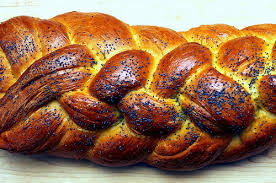
The Shabbat meals - both evening and lunchtime plus, believe it or not, Seudah Shlishit - may involve ... wait for it ... challah.
Challah

Why? Because you've got to have 'bread' for it to be considered a meal, so you can make HoMotzi, so you can bentsch Shabbos.

Therefore, defying all logic, you can serve challah right up to about 12 noonish on Saturday, as long as you keep it separate, on a separate dish - or better yet, on a paper plate.

Yes, this is in spite of the fact that you have already performed Bedikat Chametz, burnt the chametz, and publicly announced that any chametz remaining in your possession is 'ownerless property, as the dust of the earth'.

Thank G-d Judaism doesn't have to make sense! 

Wait better
The Rabbis, in their finite but still immense wisdom, thought hard and found a workaround. You guessed it!

Egg Matzo!

How, Abq Jew hears you ask, does Egg Matzo provide a workaround to what is clearly and plainly a contradiction?

Here's how: At the First Seder, we are commanded to eat Matzo lechem oni, poor-man's bread, the 'Bread of Affliction.' To prevent us from jumping the halachic gun, the Rabbis forbade us from eating lechem oni during the hours just before the First Seder. 

Here's the clincher: Egg Matzo - because that delicious egg has been added to enrich the flavor - is NOT 'Bread of Affliction'. But it is (if you've shopped carefully) Kosher for Passover!

Wait Worse

If you think Pesach on Saturday night is Moshe Kapoyre now - you should have seen in Temple times. Here's a story from the Talmud.

Hillel the Elder

Hillel Knows Some Things

The Pesach offering - we all remember the Pascal Lamb, don't we? or is Abq Jew putting Descartes before the hoarse? - had a strict time limit. 

It had to be slaughtered bayn ha’arbayim (at twilight) - and it had to be totally consumed by midnight. Which naturally raised the question:

What to do if the 14th of Nisan falls on Shabbat?

The Mishna says: The following acts necessary for the sacrifice of the Pesach offering supersede the due observance of the Sabbath: The shechting, the sprinkling of its blood, the removal of its kishkes, and the burning of the fat with incense.

The Gemara tells us: The rabbis taught: The Halakha in the Mishna was not known to the Religious Authorities.  It once happened that the 14th of Nissan occurred on a Sabbath, and they did not know whether the Passover sacrifices superseded the due observance of the Sabbath or not. In other words:

Zevachim before Pesachim, or vice versa? 

The rabbis looked around for a man who knew the Halakha, and they were told that there was a man who had recently come from Babylon, called Hillel of Babylon, and who had learned under the two greatest men of that generation, Shemayah and Abtalyon. Hillel would probably be able to solve the problem. 

They sent for Hillel and asked him: "Do you know whether the Passover-sacrifice supersedes the Sabbath?" and he answered: (condensed version) “Sure it does.”

But they insisted upon his basing his assertion upon some actual text. Which Hillel promptly provided, showing how the Torah's use of the word biMoado (at its appointed time) proved that Zevachim and the Passover offering may supersede the Shabbat offering.

When the rabbis heard this, they immediately put Hillel in charge. 

Whereupon Hillel began to reproach them, and said:

Why have you put me in charge?
You should have been taking advantage of
the learning of the two great men of
your generation, Shemayah and Abtalyon.

Paschal Lamb

Everyone knew that Passover Pilgrims were forbidden to carry their slaughtering knives to the Mikdash on Shabbat. So the Religious Authorities asked  Hillel:

What is the law if a man forgot to bring the
shechting knife on the day before the Sabbath?
Hint: No carrying knives or anything else in public on Shabbat.

Hillel not-so-famously answered:

I have heard the Halakha but have forgotten it.  

And famously continued:

Leave this, however, to the Israelites themselves,
for if they are not prophets they are descendants
of prophets, and they will know what to do.

The next day, Hillel saw that those who brought sheep as a sacrifice had the knife thrust in the wool of the sheep, and those that brought goats as a sacrifice had the knife stuck between the horns. 

Hillel then (amazingly) remembered the Halakha covering the case and exclaimed:

Thus is the tradition which I have received
from my masters Shemayah and Abtalyon.

But Hillel's remembering brings up the much larger question:

Forgetting Memory

How Could Hillel Or Anyone Else Forget?

How was it possible that, among the thousands of Passover Pilgrims who had assembled for the holiday, they could not find a single person who remembered what had been done the last time Passover followed Shabbat?

Answer #1: Blame it on God. The Talmud says: God caused the people to forget in order to make Hillel's achievement appear more impressive, and to facilitate his rapid rise to leadership.

Answer #2: Let’s do the math! Pesach on Saturday Night. How often, one wonders, doesn't one, does this happen?

JTS

Abq Jew first became aware of this question in 1977, when he was privileged to study Talmud at the Jewish Theological Seminary with now-Rabbi but then 'only' Professor Judith Hauptman

Back then - there was, you will recall, no Internet and no Google, although there was now-Rabbi Burt Visotsky, the genius who lived down the hall - Abq Jew did the research using a [printed hardcover of the] 150-Year Jewish Calendar.

And discovered that there were regular intervals of 3, 4, 7, 13, and 20 years between instances of Pesach on Saturday night. As Wikipedia tells us today:

While the coincidence of the Eve of Passover and Shabbat can occur as often as three times in a decade, it is also possible for as many as 20 years to pass between two instances. 

The percentage of the Eve of Passover on Shabbat occurring is 11.5%. 

During the 20th century, the Eve of Passover fell on Shabbat 12 times: in 1903, 1910, 1923, 1927, 1930, 1947, 1950, 1954, 1974, 1977, 1981, and 1994. 

In the 21st century, it has occurred three times: in 2001, 2005, and 2008. Future occurrences in the 21st century include 2021, 2025, 2045, 2048, 2052, 2072, 2075, 2079, and 2099.

Passover 2021

So ... 

Do you remember where, when, and with whom you celebrated Passover in 2008? In 2005? How about in 2001? Which version of the Haggadah did you use? And whose child, now likely Married With Children, asked the Four Questions?

Taking ancient life spans and 20-year gaps into account, it seems entirely reasonable to Abq Jew that living memory of what to do when Pesach begins on Saturday night might fade.

Which brings us to:

The Fourth Thing

The Fourth Thing
You've Always Wondered About

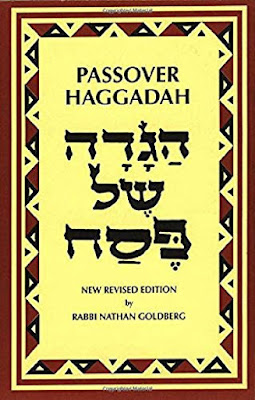
You will find the Fourth Thing You've Always Wondered About right there in the Passover Haggadah. On page 25. 

Haggadah Goldberg

It's in the blessing right before the second cup of wine, which is based on a Mishnah in Pesachim.
Blessed are You, G-d, our G-d, King of the universe, who has redeemed us and redeemed our fathers from Egypt, and enabled us to attain this night to eat Matzah and Maror.

So too, G-d, our G-d and G-d of our fathers, enable us to attain other holidays and festivals that will come to us in peace with happiness in the rebuilding of Your city, and with rejoicing in Your service [in the Bet Hamikdash].

Then we shall eat

Note: if the festival is on any day except Saturday night say:

of the sacrifices and of the Passover-offerings; 

if the Seder is on Saturday Night say: 

of the Passover-offerings and of the sacrifices

whose blood shall be sprinkled on the wall of Your altar for acceptance; and we shall thank You with a new song for our redemption and for the deliverance of our souls. Blessed are You, G-d, who redeemed Israel.

In other words: Through the liturgy, we recognize that 

The Passover-offering supersedes the Sabbath.

Ta-Da

You know - just like Hillel said.

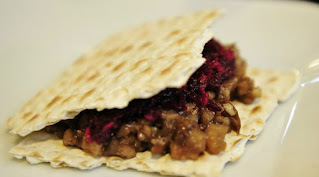
Hillel Sandwich
Here, Hillel. Have a sandwich.

Passover Shopping